Servicing Mission 3B - Another refurbishment for Hubble
|
Orbiting at a speed of about 27,200 km per hour, 570 km above the Earth, Hubble suffered from the progressive failure of several gyroscopes – responsible for keeping the observatory steady during observations – in 1999. Left unable to perform science operations until repairs were carried out, NASA split the third servicing mission in two separate flights: SM3A and SM3B. Upon successful completion of SM3A - marked by the replacement of Hubble’s gyroscopes - in December of 1999, the fourth servicing mission to the Hubble Space Telescope was launched on 1 March 2002. In preparation for this mission, the 7-astronaut Columbia crew (STS-109) underwent a training period that included extensive cross tuition and required that all astronauts received specific rehearsals tailored to their assigned tasks. Led by Commander Scott D. Altman, the crew flew aboard the Columbia Space Shuttle to the space telescope and conducted a number of extra vehicular activities to upgrade the spacecraft. The almost-12-day mission featured five spacewalks and the installation of new science instruments. Crucial to putting Hubble at the apex of its capabilities was the installation of a new scientific instrument - the Advanced Camera for Surveys (ACS) - containing advanced technology that far surpassed what had been available to the telescope to date. The ACS replaced the Faint Object Camera and brought powerful new capabilities to Hubble. It is able to gather 10 times more data than the Wide Field and Planetary Camera 2 in the same span of time. With a wide field of view, high image quality and extraordinary sensitivity, Hubble’s ACS enhanced the spacecraft’s capabilities from visible to far ultraviolet. The ACS enabled to capture the most distant image of our Universe called the Hubble Deep Field, which has helped astronomers unveil the deepest and farthest mysteries of our Universe. Although the principal task was the installation of the ACS, several other key upgrading activities were also conducted:
After numerous refurbishing and maintenance tasks during this mission, astronauts left Hubble ready to achieve its full potential and to continue revolutionising modern astronomy by carrying out new observations and delivering unseen views of our Universe. Hubble’s SM3B upgrades at a glance:
Hubble was released from the Shuttle 9 March 9:32 CET. Links |
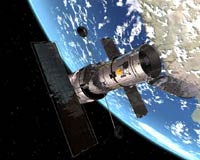
Hubble is hundreds of kilometres above Earth, but it is not totally inaccessible
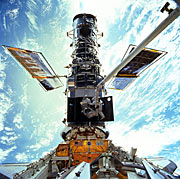
From the very beginning Hubble was designed to be astronaut-friendly.
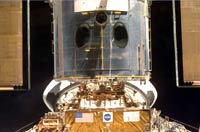
Hubble berthed in the Space Shuttle bay during Servicing Mission 3A.
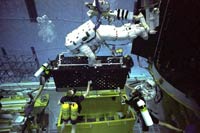
One of the SM3B astronauts during underwater tank training. |